• Skip to main content
  • Skip to secondary menu
  • Skip to primary sidebar
  • Skip to footer
  • Homepage
  • Privacy Policy
  • Contact Us
  • Post Page

YourExamInfo

Prepare for your Exams with us

  • Class 1 to 5
    • Class 1
      • Class 1 EVS
      • Class 1 Maths
    • Class 2
      • Class 2 Math
    • Class 3
      • Class 3 EVS
      • Class 3 Math
    • Class 4
      • Class 4 EVS
    • Class 5
      • Class 5 EVS
  • Class 6
    • Maths
    • Social Science
  • Class 10
    • Class 10 Social Science
Home » Class 3 » Class 3 EVS » Class 3 EVS chapter 10 question answer

Class 3 EVS chapter 10 question answer

July 1, 2023 by Leave a Comment

Welcome to the Class 3 EVS chapter 10 question-answer page. Find important extra questions for this NCERT book for Class 3 EVS Chapter 10 What is Cooking class 3 evs worksheet with answers on this page.

Table of Contents

Toggle
  • Class 3rd EVS chapter 10 question answer (NCERT Book)
    • What is Cooking class 3 EVS chapter 10 question answer
    • Match the following
    • Choose the right option:
    • Unscramble the words
    • Multiple Choice Questions
    • Answer the following questions

Class 3rd EVS chapter 10 question answer (NCERT Book)

The questions provided in the class 3 EVS worksheet, “What is Cooking,” along with their corresponding answers, have been meticulously designed to align with the content covered in the NCERT book. Engaging in additional practice using these questions will significantly enhance your academic performance, leading to improved grades at school.

To access the worksheet for practice, kindly close the accordion to conceal the answers.


What is Cooking class 3 EVS chapter 10 question answer

Match the following
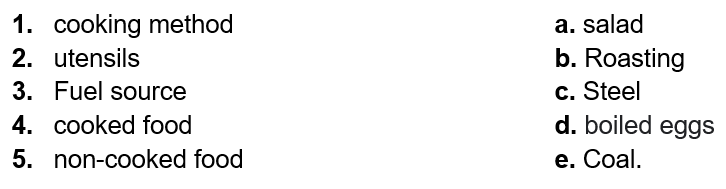
  1. b)
  2. c)
  3. e)
  4. d)
  5. a)

Choose the right option:

  1. We need to colour the spaces with _______( dots, circles) in them.
  2. Utensils used for__________(frying, cooking ) are pots, pans, spoons, spatulas, etc.
  3. We eat some things _________( raw, rotten )and some things cooked.
  4. The method of cooking in which food is cooked in an oven is called _______( baking, roasting ).
  5. To prepare lemon water, we need to mix ________(chilli, sugar ) in water and add lemon juice.
  1. dots
  2. cooking
  3. raw
  4. baking
  5. sugar

Unscramble the words

  1. egnkadin
  2. tlusnise
  3. eepnlpig
  4. ngikcoo
  5. rsadiaserhweh
  1. kneading
  2. utensils
  3. peeling
  4. cooking
  5. dishwasher

Multiple Choice Questions

Question 1. What is the purpose of soaking whole moong seeds overnight in water?
A) To cook them
B) To make them sprout
C) To dry them out
D) None of the above

Question 2. Which of the following methods of cooking is not mentioned in the chapter?
A) Grilling
B) Boiling
C) Roasting
D) Frying

Question 3. What is the purpose of asking elderly people about the utensils used earlier for cooking?
A) To find out what kind of utensils are popular now
B) To compare the materials used in modern and older utensils
C) None of the above
D) To learn about the history of cooking utensils

Question 4. Which of the following fuels is not mentioned as a way to cook food?
A) Gas
B) Solar power
C) Coal
D) Kerosene oil

Question 5. What is the purpose of the activity where students color the spaces with dots in a picture?
A) To teach them about different cooking methods
B) To improve their coloring skills
C) To develop their observation skills
D) None of the above

  1. b)
  2. a)
  3. d)
  4. b)
  5. c)

Answer the following questions

  1. What are some common utensils used for cooking, and what materials are they made of?
  2. Can you name some foods that are eaten both raw and cooked?
  3. What are some methods of cooking, and can you give examples of foods that are cooked using these methods?
  4. What are some alternative sources of fuel that can be used for cooking?
  5. What is the process for making chapatis, and why is it considered a difficult process?
  6. What is the difference between food that is cooked and food that is eaten raw?
  7. How can children learn about different cooking methods and their impact on the environment?
  8. What are some examples of foods that can be prepared without cooking?
  9. How can children develop an understanding of the different materials used for cooking utensils?
  10. Why is it important to understand the process of cooking and the different methods used?
Answers
  1. Common utensils used for cooking include pots, pans, spatulas, and spoons, among others. They can be made of various materials such as stainless steel, aluminium, non-stick materials, and wood.
  2. Some foods that are eaten both raw and cooked include vegetables like carrots, broccoli, and bell peppers, as well as fruits like apples, bananas, and grapes.
  3. Some methods of cooking include roasting (e.g. roasted chicken), boiling (e.g. boiled potatoes), frying (e.g. fried chicken), and baking (e.g. baked bread).
  4. Alternative sources of fuel for cooking include kerosene oil, coal, electricity, gas, wood, sunlight, and cow dung.
  5. The process of making chapatis involves taking out the flour, kneading it into a dough, making small balls of the dough, rolling out the balls, and cooking them on fire. It is considered a difficult process because it requires a lot of effort and skill to make perfect chapatis.
  6. Food that is cooked is heated to a certain temperature to make it more palatable and easier to digest. Raw food, on the other hand, is eaten without any heating or cooking.
  7. Children can learn about different cooking methods by observing their family members cook and by discussing it in class. They can also learn about the environmental impact of different fuel sources and discuss ways to reduce their impact.
  8. Some examples of foods that can be prepared without cooking include lemon water, fruit salad, and sandwiches.
  9. Children can develop an understanding of different materials used for cooking utensils by asking their family members, observing the utensils in their own homes, and discussing it in class.
  10. Understanding the process of cooking and the different methods used is important because it helps us appreciate the effort and skill required to prepare food. It also helps us make informed choices about the types of food we eat and the methods used to cook them.

Filed Under: Class 3, Class 3 EVS

Reader Interactions

Leave a Reply Cancel reply

Your email address will not be published. Required fields are marked *

This site uses Akismet to reduce spam. Learn how your comment data is processed.


Primary Sidebar

More to See

ASLV Full Form

GSLV Full Form

PSLV Full Form

A Shelter so High MCQ Class 5 EVS Chapter 12

A Shelter so High class 5 evs worksheet with answers

Categories

  • Class 1 (47)
  • Class 1 EVS (45)
  • Class 1 Maths (2)
  • Class 10 Geography (5)
  • Class 10 Social Science (7)
  • Class 2 (3)
  • Class 2 Math (3)
  • Class 3 (82)
  • Class 3 EVS (81)
  • Class 3 Math (1)
  • Class 4 (74)
  • Class 4 EVS (74)
  • Class 5 (36)
  • Class 5 EVS (36)
  • Class 6 maths (6)
  • Class 6 Social (52)
  • Class 7 Science (1)
  • Computer Awareness (2)
  • Exams (6)
  • Full Form (34)
  • General Knowledge (1)
  • General Science (1)
  • GK MCQ Quiz (8)
  • lkg math (1)

Recent Posts

  • Class 4 evs chapter 1 question answer April 24, 2024
  • Indian monuments quiz March 14, 2024
  • Prehistoric India Quiz March 12, 2024
  • Indian Railway Quiz March 12, 2024
  • ASLV Full Form February 28, 2024

Footer

About Us

YourExamInfo is an educational platform offering a range of resources including worksheets, MCQs, and important questions and answers for various class levels and subjects. Covering EVS, Science, Math, Social Studies, English, and Hindi for classes 1 to 10.

The website’s content is aligned with NCERT books (CBSE Board) and created by expert teachers to help students with revision and exam preparation.

Recent

  • Class 4 evs chapter 1 question answer
  • Indian monuments quiz
  • Prehistoric India Quiz
  • Indian Railway Quiz
  • ASLV Full Form

Search

Copyright © 2026 : YourExamInfo