• Skip to main content
  • Skip to secondary menu
  • Skip to primary sidebar
  • Skip to footer
  • Homepage
  • Privacy Policy
  • Contact Us
  • Post Page

YourExamInfo

Prepare for your Exams with us

  • Class 1 to 5
    • Class 1
      • Class 1 EVS
      • Class 1 Maths
    • Class 2
      • Class 2 Math
    • Class 3
      • Class 3 EVS
      • Class 3 Math
    • Class 4
      • Class 4 EVS
    • Class 5
      • Class 5 EVS
  • Class 6
    • Maths
    • Social Science
  • Class 10
    • Class 10 Social Science
Home » Class 6 » Class 6 Social » The earth in the solar system class 6 worksheets with answers

The earth in the solar system class 6 worksheets with answers

February 24, 2023 by Leave a Comment

Class 6 geography chapter 1 questions and answers

Welcome to this the earth in the solar system class 6 worksheets with answers. This worksheet contains important extra questions and answers for students that they can practice for checking their exam preparation.

Table of Contents

Toggle
  • Class 6 geography chapter 1 questions and answers
  • The earth in the solar system class 6 extra questions
    • Fill in the blanks
    • True/False Type Questions
    • Very Short Answer Type Questions
    • Short Answer type questions
    • Long Answer Type Questions
    • Answer the following questions
  • Download the earth in the solar system class 6 worksheets with answers as pdf

This worksheet includes a variety of questions such as fill-in-the-blank, true/false, and short/long answer types. They also feature extra and important questions to challenge students.

Other important articles that will help you in this chapter are


  • Class 6 Geography Chapter 1 Online Test
  • Class 6 Geography Chapter 1 The Earth in the Solar System MCQs with answers
  • The earth in the solar system class 6 notes

The earth in the solar system class 6 extra questions

Fill in the blanks

  1. ……………….. are small, rocky objects that orbit the sun.
  2. The shape of the Earth is called ………………….
  3. A ……………….. is a natural object in space, such as a planet, star, or moon.
  4. A ……………….. is a large system of stars, gas, and dust held together by gravity.
  5. A ……………….. is a massive, luminous ball of gas that produces heat and light through nuclear fusion.
  6. A ……………….. is a group of stars that appear to form a recognizable pattern in the sky.
  7. The celestial bodies which have their own heat are called …………………….
  8. Patterns formed by a group of stars is called …………………….
  9. The word planet comes from ……………………. word “Planetai”
  10. The ……………………. is the centre of our solar system.
  11. The fixed path on which the planets move around the sun is called …………………….
  12. …………………….is no longer considered a planet.
  13. Moon is the only ……………………. of earth.
  14. ……………………. was a famous astronomer of ancient India.
  15. The moon moves around earth in about ……………………. days.
  16. The name of our galaxy is ……………………. and in Hindi we call it
  17. The earth is ……………………. nearest planet to the sun and it is ……………………. largest in size. Its twin planet is …………………….
  18. A huge system of stars is called a …………………….
  19. ……………………. is the closest celestial body to our earth.
  20. Asteroids are found between the orbits of ……………………. and …………………….

Answer:

  1. Asteroids
  2. geoid
  3. Celestial Body
  4. Galaxy
  5. Star
  6. Constellation
  7. Stars
  8. Constellation
  9. Greek
  10. Sun
  11. Orbit
  12. Pluto
  13. Satellite
  14. Aryabhata
  15. 27.3
  16. Milky Way, Akash Ganga
  17. Third, Fifth, Venus
  18. Galaxy
  19. Moon
  20. Mars, Jupiter

True/False Type Questions

  1. The moon is Earth’s only natural satellite. Answer:
  2. Pluto is still considered to be a planet in our solar system. Answer:
  3. Asteroids are only found in the asteroid belt between the orbits of Mars and Jupiter.
  4. Meteoroids that survive entry into Earth’s atmosphere and hit the ground are called asteroids.
  5. The sun’s intense heat is felt more strongly on Earth than on any other planet in the solar system.
  6. All the planets move around the sun in an elongated path.
  1. True.
  2. False. Pluto was reclassified as a dwarf planet in 2006.
  3. False. Some asteroids can be found in other parts of the solar system.
  4. False. Meteoroids that survive entry into Earth’s atmosphere and hit the ground are called meteorites.
  5. False. The sun’s intense heat is not felt as strongly on Earth due to its distance from the sun.
  6. True

Very Short Answer Type Questions

  1. What is a celestial body?
  2. Which planet is closest to the sun?
  3. What is a geoid?
  4. What happens when meteoroids enter Earth’s atmosphere?
  5. What is a shooting star or meteor called when it hits the ground?
  6. What is the moon’s size compared to the Earth?
  1. A natural object in space, such as a planet, star, or moon.
  2. Mercury
  3. The shape of the Earth is slightly flattened at the poles and bulging at the equator.
  4. They are called meteors or shooting stars.
  5. Meteorite
  6. The moon is one-quarter the size of the Earth.

Short Answer type questions

  1. Which planet is called a dwarf planet and why?
  2. What is a north star?
  3. Name the planet having the maximum number of moons.
  4. Why doesn’t the moon support life
  5. What is the order of the planets in our solar system from the sun?
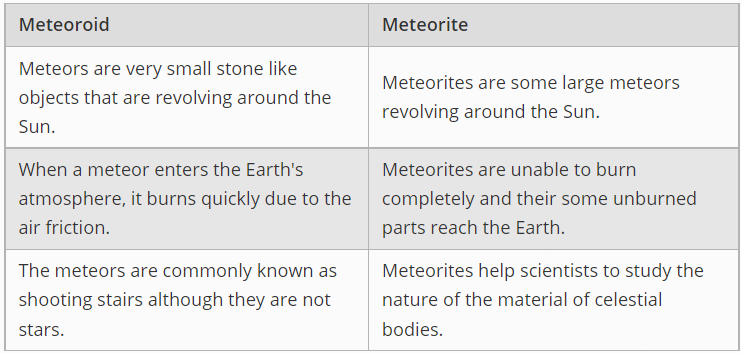
  6. Differentiate between meteoroid and meteorite.
  1. Pluto is a dwarf planet because it does not meet the criteria for a full-sized planet after the International Astronomical Union’s 2006 redefinition of planet classification. It is spherical and orbits the Sun but has not cleared its orbit of other debris, a key criterion for planet classification.
  2. The North Star (Polaris) is the brightest star in the Ursa Minor constellation, positioned near the North Pole. It’s used as a reference point for celestial navigation because it remains stationary in the night sky.
  3. Jupiter has the maximum number of moons of any planet in our solar system. Jupiter’s strong gravitational pull and large size make it capable of capturing and holding onto a large number of moons.
  4. The Moon lacks many life-supporting elements. No atmosphere, liquid water, or severe temperatures exist on the Moon. No magnetic field shields it from solar energy. Without these parameters, life on the Moon cannot exist.
  5. The order of the planets in our solar system from the sun is Mercury, Venus, Earth, Mars, Jupiter, Saturn, Uranus, and Neptune.
Long Answer Type Questions

  1. Why is Venus considered as ‘Earth’s Twin’?
  2. Why do we always see only one side of the Moon?
  3. Why is the Earth called ‘Blue Planet’?
  4. What is a constellation?
  5. Write down the main features of the moon.
  1. Venus is known as Earth’s Twin because of its similar size and shape. With a diameter that is approximately 95% of Earth’s, Venus is also the closest planet to our planet in terms of size. It’s much hotter due to a thick atmosphere of carbon dioxide that causes a runaway greenhouse effect, resulting in an extreme surface temperature of around 460°C.
  2. The Moon is in synchronous rotation with the Earth, meaning it takes almost the same amount of time to complete one rotation on its axis as it does to orbit the Earth. As a result, we only ever see one side of the Moon from Earth.
  3. The Earth is often referred to as the ‘Blue Planet’ because of the large amount of water that covers its surface. About 71% of the Earth’s surface is covered in water, which reflects blue light from the Sun. This blue reflection gives the planet its characteristic blue appearance when seen from space.
  4. A constellation is a group of stars that forms a recognizable pattern or shape in the night sky. These patterns have been named and recognized by cultures around the world for thousands of years. One well-known constellation is Ursa Major, which is also known as the Big Bear.
  5. The main features of the moon are
    1. The Moon is a natural satellite of the Earth and is the fifth-largest moon in the solar system.
    2. It is about 3,84,400 km. away from the Earth.
    3. It has a rocky surface covered in craters, mountains, and valleys.
    4. Its diameter is only one-fourth of the Earth’s.
    5. The Moon has no atmosphere, no water, and no life, but it does have a weak gravitational pull that affects the tides on Earth.
    6. It looks so big because it is not very far from the Earth.

Answer the following questions

  1. What is meant by the solar system?
  2. To which galaxy does our solar system belong?
  3. Name the planets which have rings around them. What are these rings made up of? Is it possible for us to see these rings?
  4. Which are the 2 types of movement of the planets?
  5. Why is Earth called a unique planet?
  1. The solar system is a system in space that includes the Sun, eight planets, their moons, and all other celestial bodies that orbit the Sun.
  2. Our solar system belongs to the Milky Way galaxy.
  3. The planets that have rings around them are Jupiter, Saturn, Uranus, and Neptune. These rings are made up of ice, dust, and rock particles. Yes, it is possible to see these rings with the help of a telescope.
  4. The two types of movement of the planets are rotation (spinning on their own axis) and revolution (moving around the Sun).
  5. Earth is called a unique planet because it is the only known planet to support life. It has water in liquid form and a suitable atmosphere for living organisms.

Download the earth in the solar system class 6 worksheets with answers as pdf

The-earth-in-the-solar-system-class-6-questionsDownload

Filed Under: Class 6 Social

Reader Interactions

Leave a Reply Cancel reply

Your email address will not be published. Required fields are marked *

This site uses Akismet to reduce spam. Learn how your comment data is processed.


Primary Sidebar

More to See

ASLV Full Form

GSLV Full Form

PSLV Full Form

A Shelter so High MCQ Class 5 EVS Chapter 12

A Shelter so High class 5 evs worksheet with answers

Categories

  • Class 1 (47)
  • Class 1 EVS (45)
  • Class 1 Maths (2)
  • Class 10 Geography (5)
  • Class 10 Social Science (7)
  • Class 2 (3)
  • Class 2 Math (3)
  • Class 3 (82)
  • Class 3 EVS (81)
  • Class 3 Math (1)
  • Class 4 (74)
  • Class 4 EVS (74)
  • Class 5 (36)
  • Class 5 EVS (36)
  • Class 6 maths (6)
  • Class 6 Social (52)
  • Class 7 Science (1)
  • Computer Awareness (2)
  • Exams (6)
  • Full Form (34)
  • General Knowledge (1)
  • General Science (1)
  • GK MCQ Quiz (8)
  • lkg math (1)

Recent Posts

  • Class 4 evs chapter 1 question answer April 24, 2024
  • Indian monuments quiz March 14, 2024
  • Prehistoric India Quiz March 12, 2024
  • Indian Railway Quiz March 12, 2024
  • ASLV Full Form February 28, 2024

Footer

About Us

YourExamInfo is an educational platform offering a range of resources including worksheets, MCQs, and important questions and answers for various class levels and subjects. Covering EVS, Science, Math, Social Studies, English, and Hindi for classes 1 to 10.

The website’s content is aligned with NCERT books (CBSE Board) and created by expert teachers to help students with revision and exam preparation.

Recent

  • Class 4 evs chapter 1 question answer
  • Indian monuments quiz
  • Prehistoric India Quiz
  • Indian Railway Quiz
  • ASLV Full Form

Search

Copyright © 2026 : YourExamInfo